2025 Audi S3 & RS3: Refresh Worth the Price?
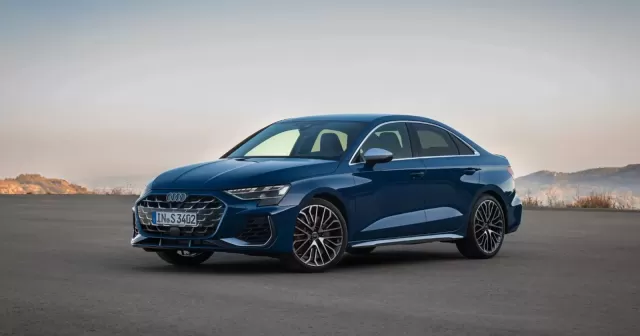
Audi has breathed new life into its compact luxury sport sedans for the 2025 model year. Expect amplified power, striking new lighting designs, and refined aesthetics. However, these models still rely on the MQB platform, a foundation dating back to 2015. The question remains: are these enhancements sufficient to maintain their competitive edge?
The S3 starts at approximately $50,000, while the upgraded test model reached around $61,000. Think of the S3 as Audi's rendition of the acclaimed Volkswagen Golf R hatchback. Its 2.0-liter turbocharged inline-four engine now delivers 328 horsepower, a notable increase from the previous 306. It maintains 295 lb-ft of torque, now offering peak power across a broader spectrum. Expect a 0-60 mph time of 4.4 seconds, though some turbo lag is present.
Stepping up to the RS3 Quattro, the base price is roughly $65,000, while the tested model with the Dynamic Plus package pushed upwards of $77,000. This model boasts a 2.5-liter inline-five engine producing 394 hp and 369 lb-ft of torque. The acceleration is ferocious, pulling strongly through the entire rev range. The RS3 launches from 0-60 mph in a blistering 3.5 seconds.
Visually, the RS3 showcases a more aggressive front fascia and a unique "squircle" steering wheel. The RS3 unfortunately ditches physical buttons for screen-based controls, unlike the S3. The prominent exhaust outlets on the rear are mainly for show, with the actual openings not significantly enlarged. However, the sound they generate is truly captivating, particularly with the optional RS Sport Exhaust emphasizing the five-cylinder's distinctive rumble.
The seven-speed dual-clutch automatic transmission exhibits proactive behavior, aggressively downshifting on steep declines, even without activating Sport mode. On winding roads, the car demonstrates impressive grip, minimal tire squeal, and exceptional braking performance. Surprisingly, it remains composed and comfortable in urban environments, with a ride quality that is reasonably smooth and quiet.
The RS3's torque-vectoring rear differential effectively masks its underlying front-wheel-drive architecture. This system delivers a driving experience reminiscent of a rear-biased all-wheel-drive vehicle, drawing comparisons to the GT-R rather than the Golf R. This differential enhances agility, allowing drivers to confidently navigate corners with precision.
Interestingly, some preferred the S3's interior design. While the lime green accents in the test RS3 were appreciated, both models suffer from an overabundance of hard plastics and piano black finishes. These materials detract from the premium feel and do not sufficiently differentiate themselves from Volkswagen interiors.
The RS3 excels in performance but comes at a higher cost and compromises on interior quality. The S3, still impressively fast, emerges as the more sensible option for many, considering the price difference. Despite some suggesting a preference for a Volkswagen, the Audis possess distinct characters, captivating exhaust notes, and a sophisticated elegance.
These evaluations were part of a broader Car of the Year (COTY) assessment, where vehicles are judged on efficiency, design, safety, engineering, value, and how well they fulfill their intended purpose. To be considered, vehicles must be either entirely new or significantly updated.