A Tiny Terror from the Past: Unearthing Janjucetus dullardi, the 'Shark Whale' of Australia
A Tiny Terror from the Past: Unearthing Janjucetus dullardi, the 'Shark Whale' of Australia
For millions of years, the vast oceans have teemed with creatures both majestic and terrifying. While we often think of whales as gentle giants, new discoveries are constantly rewriting our understanding of their evolutionary history. Recently, a remarkable fossil find on the Victorian coast of Australia has revealed a previously unknown species of ancient whale, one that challenges our perceptions of these marine mammals. Meet Janjucetus dullardi, a miniature predator from the Oligocene epoch, affectionately nicknamed the "shark whale" due to its unique dental features.
The Discovery: A Beachcomber's Lucky Break
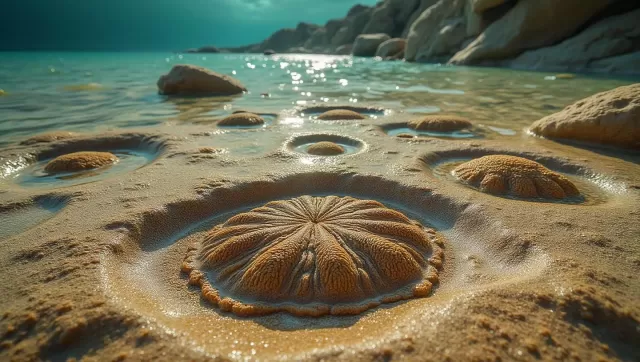
The story begins in 2019 with Ross Dullard, a local school principal with a keen eye for the unusual. While walking along the beach near Jan Juc, Victoria, he stumbled upon a fossilized skull protruding from the sand. Recognizing its potential significance, Dullard promptly donated the specimen to Museums Victoria. This act of public engagement proved invaluable, as it kickstarted a scientific investigation that would change our understanding of whale evolution.
Delving into the Past: What Makes Janjucetus dullardi So Special?
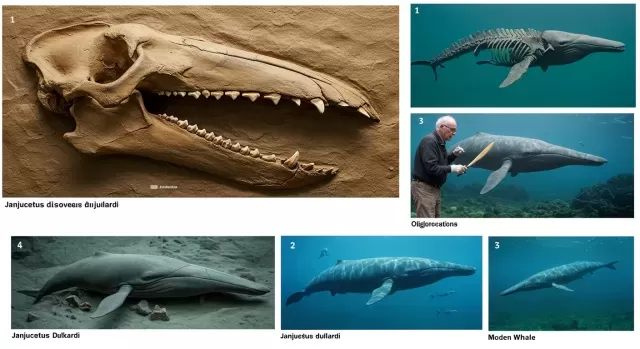
Janjucetus dullardi, named in honor of its discoverer, lived approximately 25 million years ago during the Oligocene period. This epoch was characterized by a generally warmer climate and higher sea levels compared to today. The fossil discovered represents a juvenile individual, estimated to have been around 2 to 2.2 meters in length, meaning a fully grown adult was likely closer to 3 meters. While this may sound sizable, it's dwarfed by its modern baleen whale relatives, like the blue whale, some of the largest animals on Earth.
What truly sets Janjucetus apart is its distinctive dentition. Unlike modern baleen whales, which filter feed using baleen plates, Janjucetus possessed a formidable set of razor-sharp teeth. These teeth, deeply rooted in a robust skull, were designed for gripping and tearing prey, suggesting a carnivorous diet. This characteristic earns it the "shark whale" moniker, painting a stark contrast to the gentle filter feeders we typically associate with whales.
Here's a comparison to highlight the differences:
| Feature | Janjucetus dullardi | Modern Baleen Whales (e.g., Blue Whale) |
|---|---|---|
| Size | ~3 meters | Up to 30 meters |
| Feeding Method | Carnivorous, sharp teeth | Filter feeding, baleen plates |
| Habitat | Subtropical seas | Varied, global |
| Skull | Heavily built, robust | Streamlined, adapted for filter feeding |
The whale also had relatively large eyes, nearly the size of tennis balls. This suggests they were likely adept hunters in waters that may not have been crystal clear.
Unraveling the Evolutionary Puzzle
Janjucetus dullardi is classified as a mammalodontid, an extinct group of early whales that represent an "early offshoot" of the baleen whale family tree. These creatures provide crucial insights into the evolutionary transition from carnivorous ancestors to the filter-feeding giants we know today. The discovery of Janjucetus helps fill in the gaps in our understanding of how baleen whales evolved their unique feeding mechanisms.
Professor John Long of Flinders University highlights the importance of such finds, stating that examining the fossil record allows us to "see the stages of how they acquired their special characters."
A Window into a Warmer World
The Jan Juc Formation, where the fossil was found, provides further clues about the environment in which Janjucetus thrived. Fossilized plankton discovered in the same rock layers suggest that the seas off southern Australia were significantly warmer during the Oligocene, resembling the subtropical waters off Coffs Harbour today.
This warmer environment supported a diverse array of marine life, including giant penguins, sharks much larger than today's great whites, and various other primitive dolphins and whales. According to Dr. Fitzgerald, this period marked "a turning point in the history of life in the oceans, and the beginning of an explosion in the diversification of whales and dolphins."
The Importance of Citizen Science
The discovery of Janjucetus dullardi underscores the vital role that members of the public can play in scientific discovery. Ross Dullard's keen observation and willingness to donate the fossil to science were instrumental in this groundbreaking research. As Dr. Fitzgerald emphasizes, "It's a reminder that world-changing fossils can be found in your own back yard."
Victoria's rich fossil heritage, as noted by Professor Long, makes it a prime location for paleontological discoveries. With a little knowledge and a sharp eye, anyone can potentially contribute to our understanding of the past.
The Future of Whale Research
The discovery of Janjucetus dullardi has reignited interest in the early evolution of whales and the role of mammalodontids in shaping the lineage of modern baleen whales. Further research on this and other fossil specimens will undoubtedly shed more light on the fascinating history of these iconic marine mammals.
FAQs
1. What is a baleen whale?
Baleen whales are a group of whales that filter feed using baleen plates instead of teeth. Examples include blue whales, humpback whales, and gray whales.
2. What does it mean to be an "early offshoot" of the baleen whale family tree?
This means that mammalodontids like Janjucetus were an early group of whales that branched off from the main evolutionary line leading to modern baleen whales. They possessed characteristics that were transitional between carnivorous ancestors and the filter-feeding whales of today.
3. Why is the discovery of Janjucetus dullardi important?
This discovery provides crucial insights into the evolutionary history of whales, particularly the transition from carnivorous ancestors to filter-feeding baleen whales. It helps fill in the gaps in our understanding of how these animals evolved their unique feeding mechanisms.
4. How can I get involved in paleontology?
Many museums and universities offer volunteer opportunities for members of the public to assist with fossil preparation, research, and outreach. You can also join local fossil clubs or participate in citizen science projects. Remember to always obtain permission before collecting fossils on private or public land.