Ancient Seafloor Chemistry Preserved Delicate Life
For hundreds of millions of years, the fossil record has favored the hard and the durable. Creatures lacking skeletal structures or protective shells, such as prehistoric jellyfish, typically vanish without a trace. This is especially true in sandstone environments, where coarse grains and turbulent waters generally dismantle organic remains before they can be immortalized in stone.
Yet, the Ediacaran period, roughly 570 million years ago, presents a fascinating contradiction. During this era, the seafloor was inhabited by soft-bodied organisms that were somehow preserved in exquisite detail within sandy sediments. These fossils, known as the Ediacara Biota, have puzzled scientists for decades, representing a critical bridge in the history of complex life.
The Enigma of the Ediacara Biota
The Ediacara Biota are among the most peculiar organisms to ever inhabit Earth. Their physical forms often defy modern biological categories, displaying features such as:
- Triradial symmetry (three-fold patterns rarely seen today).
- Intricate fractal branching that mimics leaves or ferns.
- Spiraling appendages that suggest a unique evolutionary path.
Because these creatures appeared just before the Cambrian Explosion—a famous surge in animal diversity around 540 million years ago—understanding them is vital. Rather than seeing the Cambrian period as a sudden biological "big bang," paleontologists now view the Ediacaran era as a foundational phase where complexity and size began to scale upward.
A Geochemical Breakthrough in Fossilization
A team led by Dr. Lidya Tarhan, a paleontologist at Yale University, recently sought to solve the mystery of how these fragile forms survived the pressures of time. Their research, published in the journal Geology, suggests that the secret lies not in the toughness of the organisms themselves, but in the specific chemistry of the ancient oceans.
By analyzing lithium isotopes in specimens from Canada and Newfoundland, the researchers tracked the mineralogical changes that occurred during burial. This chemical "fingerprint" allowed them to distinguish between two types of clay:
- Detrital Clays: Minerals transported from land and deposited in the sea.
- Authigenic Clays: Minerals that form directly on the seafloor through chemical reactions.
The study revealed that while land-based clay particles were present, they served as a foundation for authigenic clays to grow. In the silica-rich and iron-heavy waters of the Ediacaran period, these minerals precipitated rapidly around the buried organisms.
Nature's Own Casting Process
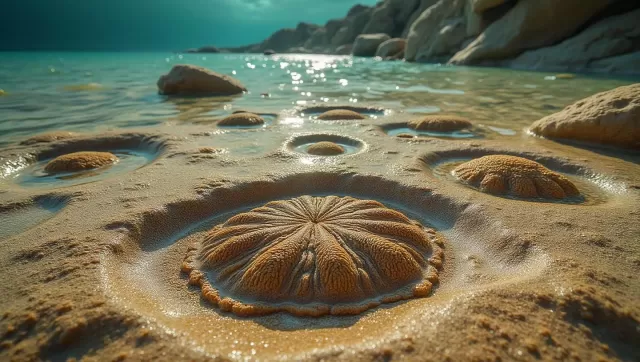
The formation of these authigenic clays acted as a biological cement. As the minerals grew, they encased the soft tissues of the Ediacara Biota, creating a rigid mold before the organisms could decay or be crushed by the weight of overlying sand. This process explains why such delicate impressions are found in sandstone—the minerals effectively turned the sand into a high-resolution recording medium.
This discovery fundamentally changes how scientists interpret the fossil record of this era. For a long time, it was hypothesized that these ancient creatures must have been exceptionally sturdy or chemically resistant to survive as fossils. Instead, it appears their preservation was a "geochemical fluke" fueled by the unique composition of the prehistoric seafloor.
Implications for the Future of Paleontology
The success of the lithium isotope method opens new doors for investigating other "exceptional" fossil sites where soft tissues are preserved. By understanding the specific environmental triggers that lead to fossilization, scientists can better determine whether the fossils we find are truly representative of ancient ecosystems or if they are simply the only things the environment allowed us to see.
Moving forward, this research provides a more robust framework for evaluating the rise and eventual disappearance of the Ediacara Biota. As researchers apply these geochemical tools to other regions, they hope to clarify the drivers behind the first great expansion of complex life on our planet.