Deadwood: Vital for Wild Orchid Seedlings and Growth
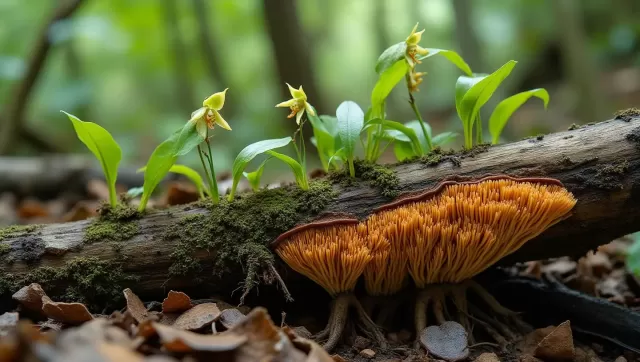
New research from Kobe University has revealed a fascinating symbiotic relationship between wild orchids and the fungi that decompose deadwood. This discovery sheds light on the critical role of these fungi in providing essential carbon to germinating orchid seeds, a process previously not well understood.
Orchid seeds, notoriously small and lacking nutrient reserves, face a significant challenge in their early development. While it was known that adult orchids rely on specific fungi that colonize their root systems, the involvement of these fungi in the initial germination phase remained unclear. Traditional research methods, hampered by the difficulty of locating and extracting tiny orchid seedlings from soil, have primarily focused on the fungal associations in adult roots.
The research team, led by plant evolutionary ecologist Kenji Suetsugu, made a crucial observation during field studies: a consistent pattern of orchid seedlings and adult plants with juvenile root structures clustered near decaying logs. This recurring association prompted them to investigate the potential role of deadwood fungi in fueling orchid growth from the very beginning.
Their findings, published in the journal Functional Ecology, confirmed that orchid seed germination occurred almost exclusively near decaying logs. Moreover, the seedlings exhibited a strong and specific association with wood-decaying fungi. The researchers noted a remarkable consistency between the fungi colonizing seedlings and those found in adult orchids with distinctive coral-shaped rhizomes, specialized root structures associated with wood decay. The team believes that orchids lacking these rhizomes may transition to different fungal partners as they mature, adapting to changes in their nutritional needs and the diminishing carbon source provided by the decaying wood.
This close partnership with wood-decaying fungi may have played a pivotal role in the evolution of mycoheterotrophy within the orchid family. Mycoheterotrophic plants have completely abandoned photosynthesis, relying entirely on fungi for their nutritional needs. The research suggests that orchids that maintain their association with wood-decaying fungi throughout their life cycle were more likely to evolve this unique adaptation.
The study highlights the significance of deadwood as a major carbon source in forest ecosystems, particularly in warm, humid environments. By associating with wood-decaying fungi, orchids gain access to this crucial resource, enabling them to thrive even in the shaded understory where sunlight is limited.
The implications of this research are far-reaching. From a conservation perspective, it underscores the importance of protecting deadwood and its associated fungi in order to safeguard wild orchid populations. From an ecological standpoint, it unveils a previously unrecognized carbon pathway from deadwood to living plants, clarifying how seedlings can establish themselves in dark forest environments. Ultimately, it demonstrates that deadwood is not simply decaying matter, but rather a vital foundation for new life.
This research was supported by grants from the Japan Science and Technology Agency, the Japan Society for the Promotion of Science, and the Research Institute for Humanity and Nature.