
Gull Deterrence: The Science of Your Voice
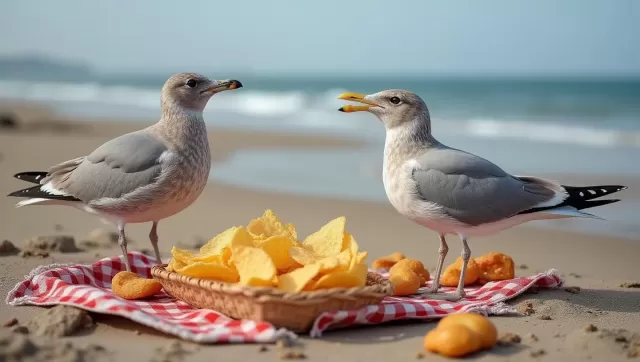
Have you ever enjoyed a peaceful seaside lunch, only to find yourself locked in a tense standoff with a bold, feathered scavenger? For many, the sight of a herring gull eyeing their food triggers a wave of panic, leading to frantic hand-waving or a hasty retreat. But what if the most effective weapon in this coastal conflict was not a physical gesture, but your voice? Groundbreaking research suggests that the key to safeguarding your chips may lie in the specific tone and intent behind your words.
The Science of Scavenging: A Unique Gull Deterrence Study
Animal behaviourists from the University of Exeter embarked on a novel mission to decode gull behavior. Their goal was to move beyond anecdotal advice and establish, scientifically, the most effective way to deter these intelligent birds. The study was conducted in a real-world setting: the bustling seaside towns of Cornwall. Researchers placed an irresistible bait—a portion of chips—in areas frequented by gulls, setting the stage for a controlled experiment.
Once a gull took interest and approached the food, the researchers played one of three pre-recorded sounds. This methodology was crucial, as it removed human body language and variable volume from the equation, isolating the acoustic properties of the human voice as the sole variable.
The Three Audio Stimuli Used in the Experiment:
- Shouting Male Voice: A recording of a man emphatically saying, "No, stay away, that's my food, that's my pasty!"
- Speaking Male Voice: The same man, using the same words, but in a calm, conversational tone.
- Control Sound: The neutral and non-threatening birdsong of a robin.
A key detail of the study design was that the "shouting" and "speaking" recordings were played at the exact same volume. This meant any difference in the gulls' reactions could not be attributed to loudness alone, but rather to the way the words were delivered.
Revealing Results: How Gulls Respond to Human Tones
The findings, drawn from observing 61 gulls across nine different locations, provided clear and surprising insights into how these birds perceive human communication.
The most dramatic reaction was to the shouting voice. When confronted with this assertive tone, nearly half (a significant percentage) of the gulls took flight and left the area within 60 seconds. The shouting was clearly interpreted as a direct and immediate threat.
The speaking voice also had a deterrent effect, but a less forceful one. Only 15% of the gulls exposed to the calmly spoken words actually flew away. However, the majority of the remaining birds did not stay to eat; they walked away from the food, suggesting they were still wary and sensed potential danger, but not enough to warrant a full-scale flight response.
In stark contrast, the robin's song had almost no effect. A overwhelming 70% of the gulls hearing this neutral sound felt comfortable enough to stay put and continue their approach toward the chips.
The following table summarizes the behavioral responses observed in the study:
| Vocal Stimulus Played | Percentage of Gulls that Flew Away | Percentage of Gulls that Stayed Put | Overall Deterrence Level |
|---|---|---|---|
| Shouting Male Voice | Nearly 50% | Low | High (Immediate Flight) |
| Speaking Male Voice | 15% | Low | Medium (Cautious Retreat) |
| Robin Song (Control) | Very Low | 70% | None |
Beyond Volume: A Breakthrough in Animal Communication
This research is believed to be the first of its kind to demonstrate that wild, non-captive animals can discern nuanced differences in human vocalizations. The fact that the gulls reacted differently to the shouting and speaking voices—despite identical volume and word content—points to a sophisticated level of perception.
Dr. Neeltje Boogert from the University of Exeter's Centre for Ecology and Conservation explained the nuance: "We found that urban gulls were more vigilant and pecked less at the food container when we played them a male voice, whether it was speaking or shouting. But the difference was that the gulls were more likely to fly away at the shouting and more likely to walk away at the speaking."
This finding challenges the assumption that only domesticated animals like dogs, pigs, and horses, which have evolved alongside humans for generations, are attuned to the subtleties of our voices. It appears that urban herring gulls, through their constant proximity to people, have learned to pay attention to the intent and emotion behind our speech.
Practical Tips for Protecting Your Picnic
So, what does this mean for your next trip to the coast? Instead of wild, ineffective flapping or abandoning your meal, you now have a science-backed strategy.
- Be Assertive, Not Just Loud: It's not about screaming at the top of your lungs. The study shows that the tone of urgency and command is what matters. A firm, sharp "Hey!" or "Get away!" is likely more effective than a loud but panicked shriek.
- Talking Can Work Too: If you're not comfortable with shouting, even speaking firmly to the gull can make a difference. It may not cause it to fly off immediately, but it will often make the bird hesitate and back away, buying you time to secure your food.
- A Peaceful Coexistence: This research highlights a non-confrontational way to manage interactions with gulls. As Dr. Boogert notes, "They are a species of conservation concern, and this experiment shows there are peaceful ways to deter them that don't involve physical contact." Understanding their behavior allows for a more harmonious shared space.
An unexpected finding from the research was that gulls in highly tourist-centric spots like St. Ives were bolder than those in more populated towns like Penzance. This suggests that gulls learn from experience; those constantly exposed to tourists and their scraps become more adept and persistent foragers.
Frequently Asked Questions (FAQs)
1. Will this work with any type of seagull?
The study specifically focused on herring gulls, which are one of the most common and bold species in many coastal urban areas. While the principles may apply to other similar gull species, their individual temperaments and levels of urban adaptation can vary.
2. Does the content of what I say matter?
The research indicates that the acoustic properties and tone are more important than the specific words. The gulls responded to the emotion and intent (assertiveness) in the voice, not the dictionary meaning of "pasty" or "food." A firm command in any language would likely yield a similar result.
3. Would a woman's voice be as effective as a man's?
The current study only tested a male voice. The researchers have noted that a future area of study would be to investigate whether a female voice, or a higher-pitched shout, elicits a different response from the gulls.
4. Is it safe to shout at a gull that is very close to me?
While the study shows shouting is an effective deterrent, always use common sense. If a gull is within pecking distance, sudden aggressive movements or loud noises could be perceived as a direct attack and provoke a defensive reaction. The method is most effective as a preemptive warning when a gull is eyeing your food from a short distance away.