Mars: The Red Planet's Climate Influence
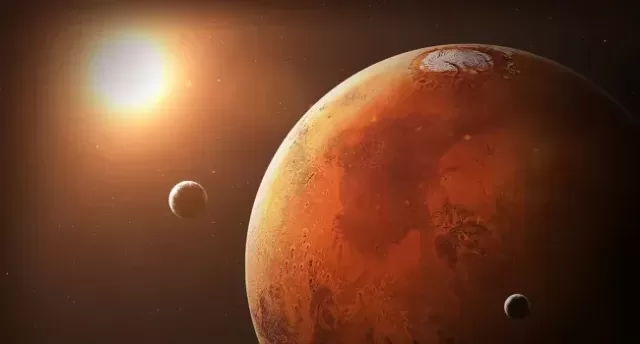
While often overshadowed by its larger neighbor, Mars plays a surprisingly significant role in Earth's long-term climate stability. This "small but mighty" planet, our celestial companion, exerts a gravitational influence that has been crucial in defining the very conditions that allow life to flourish on our home world.
Mars' Gravitational Grip on Earth's Climate
Despite its considerably smaller size and mass compared to Earth, Mars exerts a powerful gravitational tug that influences our planet's orbital path, axial tilt, and position relative to the sun. These subtle but consistent forces are key drivers of long-term climate patterns, including the cyclical occurrence of ice ages.
Earth's climate is largely governed by what are known as Milankovitch cycles. These are long-term variations in our planet's orbit and tilt, influenced by the gravitational forces of other planets in our solar system. While Venus and Jupiter have a pronounced effect on a prominent 430,000-year cycle, the impact of Mars was initially underestimated.
However, research indicates that Mars "punches above its weight." When Mars is removed from climate models, two significant climate cycles, one lasting 10,000 years and another 2.3 million years, vanish. Conversely, increasing the hypothetical mass of Mars leads to a shortening of these cycles, demonstrating its substantial influence.
These cycles dictate critical aspects of Earth's orbital mechanics:
- Orbital Eccentricity: How circular or elongated Earth's path around the sun is.
- Perihelion Timing: When Earth is closest to the sun in its orbit.
- Axial Obliquity: The tilt of Earth's rotational axis.
These factors collectively determine the amount of solar radiation that reaches different regions of Earth, thereby influencing glacial cycles and shaping our planet's climate over vast timescales, including the onset and retreat of ice ages. Mars' distance from the sun contributes to its gravitational leverage; being further out allows its pull to have a greater impact on Earth's orbit than if it were closer.
Broader Implications for Habitability and Evolution
Mars' gravitational influence also contributes to the remarkable stability of Earth's axial tilt, which varies within a relatively narrow range. While the Moon is often credited with this stabilizing effect, simulations suggest Mars' gravity plays an equally vital role. This stability is crucial for preventing drastic wobbles in Earth's tilt, which could otherwise lead to extreme climate fluctuations incompatible with life as we know it.
The stabilizing effect of Mars implies that exoplanets located in habitable zones of other star systems might not require a large moon to maintain a stable climate. The gravitational influence of outer planets in those systems could similarly contribute to the habitability of Earth-like worlds.
The impact of ice ages, driven in part by these Martian-influenced cycles, has been profound. They have reshaped Earth's landscapes, leading to:
- Shrinkage of forests.
- Expansion of grasslands.
- Triggering major evolutionary leaps, such as the development of bipedalism, tool use, and cooperative behaviors.
This raises a fascinating thought experiment: the trajectory of human and animal evolution might have been dramatically different, or perhaps impossible, without the subtle but persistent gravitational influence of Mars.