
Offshore Wind Projects Resume After Legal Battles
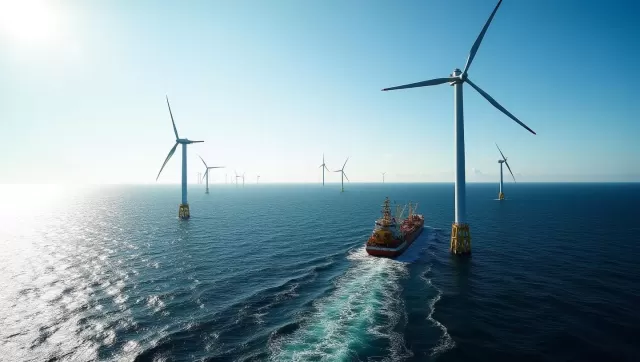
Offshore wind development on the East Coast has received a significant boost as federal judges have allowed construction to resume on several major projects. The Department of the Interior, under the Trump administration, had previously halted work on five offshore wind farms, citing national security concerns related to potential radar interference. However, judicial intervention has cleared the way for three key projects to move forward.
Projects Given Green Light
Revolution Wind, located off the coast of Rhode Island, Empire Wind near New York, and Coastal Virginia Offshore Wind, will now be able to restart construction activities. These projects collectively represent a substantial 6 gigawatts of potential generating capacity. The developers had promptly challenged the 90-day stop-work order, which was issued just before the Christmas holiday.
Radar Concerns and Judicial Skepticism
The government's stated reason for the halt was the potential for wind turbines to interfere with radar operations. While acknowledged as a valid concern, the article notes that mitigation strategies, such as strategic turbine placement and radar equipment upgrades, have been explored and debated throughout the permitting process. President Trump himself has publicly expressed his skepticism towards wind power, stating he is "not much of a windmill person."
However, early legal proceedings revealed that the administration's arguments did not impress the judges. In multiple courtrooms, the government's reasoning was met with skepticism. U.S. District Judge Carl Nichols, a Trump appointee, highlighted the Interior Department's failure to adequately address the arguments presented by Equinor, the developer of Empire Wind. Equinor had argued that the stop-work order was "arbitrary and capricious," a point Nichols emphasized by noting the term wasn't even included in the government's brief. He also questioned the logic of halting construction when the primary national security concern appeared to be the operational phase of the wind farms.
Similarly, U.S. District Judge Jamar Walker, presiding over the lawsuit filed by Dominion Energy for the Coastal Virginia Offshore Wind project, raised comparable questions. Judge Walker also suggested that the Interior Department's order was excessively broad in its application to the Virginia project.
Projects Still Awaiting Decisions
Two other offshore wind projects, Sunrise Wind and Vineyard Wind 1, remain in a state of uncertainty as their legal challenges continue. A hearing for Sunrise Wind is scheduled for early February, while the lawsuit for Vineyard Wind 1 was only recently filed.
The Vast Potential of Offshore Wind
The East Coast holds immense potential for offshore wind energy, with a Department of Energy study projecting up to 110 gigawatts of capacity by 2050. This expansion could significantly benefit densely populated urban centers and critical data center regions. The Northeast currently faces some of the highest electricity costs in the nation, and the Mid-Atlantic region's grid operator has faced scrutiny over rising prices. As one of the most cost-effective forms of new electricity generation, offshore wind offers a promising avenue to stabilize or even reduce these escalating costs. On a national level, offshore wind could generate an estimated 13,500 terawatt-hours of electricity annually, a figure three times greater than the United States' current total electricity consumption.