
Quantum Gas Defies Heating, Upending Physics
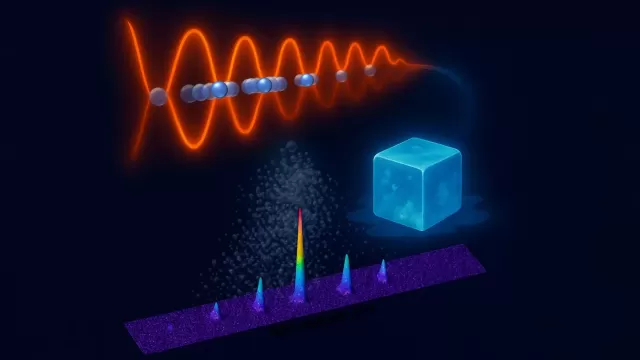
Common sense dictates that friction and force generate heat. Whether you are vigorously rubbing your hands together on a cold day or hammering a piece of metal, the continuous application of energy typically results in a temperature spike. For a long time, physicists operated under the assumption that this rule held true even at the microscopic level. The prevailing theory suggested that if you continuously drive a system of interacting particles, it will steadily absorb energy, eventually resulting in a chaotic, heated state.
However, recent findings have upended this classical intuition. In a groundbreaking experiment conducted at the University of Innsbruck, researchers discovered that under specific conditions, a strongly driven quantum system can actually refuse to heat up, defying the expected trajectory of thermalization.
Defying the Laws of Heating
The research team, led by Hanns Christoph Nägerl at the Department of Experimental Physics, constructed a unique environment to test the limits of quantum stability. They utilized a one-dimensional quantum fluid comprised of atoms cooled to temperatures hovering just nanokelvins above absolute zero.
To introduce energy into the system, the scientists utilized a pulsed laser setup. This created a lattice potential that flickered on and off, effectively "kicking" the atoms repeatedly. In a standard scenario, this constant external driving force should act like a person jumping on a trampoline, where each bounce adds more height and energy. The atoms were expected to absorb this kinetic energy continuously, causing their momentum to spread outward indefinitely.
A Freeze in Momentum
Contrary to these predictions, the system behaved in a startlingly orderly fashion. While the atoms initially absorbed energy, the process came to an abrupt halt. The kinetic energy hit a ceiling and leveled off, even though the laser continued to drive the system and the atoms continued to interact with one another.
Instead of devolving into a heated, chaotic mess, the system entered a rare state known as Many-Body Dynamical Localization (MBDL). In this state, the physical expansion of momentum is arrested. The atoms became locked in place within momentum space, maintaining their structure rather than drifting into diffusive behavior.
According to the research team, this stability is maintained by two primary quantum factors:
Quantum Coherence: The phases of the wave functions remain correlated.
Many-Body Entanglement: The complex connections between particles prevent the energy from randomizing.
The result was a system that remained "cool" and orderly despite being subjected to conditions that should have forced it to burn up.
The Role of Quantum Coherence
To verify that this freezing effect was indeed a product of quantum mechanics and not a fluke, the researchers introduced a variable to sabotage the system: randomness.
By altering the driving sequence to include disordered patterns, the protective shell of MBDL vanished. The introduction of randomness destroyed the quantum coherence. Immediately, the atoms reverted to expected behavior—their momentum spread rapidly, and the system began to heat up without limit. This confirmed that the orderly "freezing" phenomenon relies entirely on maintaining a coherent, structured driving force.
Implications for Quantum Tech
The ability to halt heating in a driven system is more than just a theoretical curiosity; it solves a practical problem for future technology. One of the primary hurdles in building robust quantum computers and simulators is the fragility of quantum states. Energy buildup and thermalization typically destroy the delicate information held within these systems.
This discovery offers a new blueprint for stability. By understanding how to access the MBDL state, engineers may be able to design systems that:
Resist Chaos: Maintain stability even when pushed far from equilibrium.
Prevent Decoherence: Shield quantum information from the destructive effects of heat.
Enhance Simulation: Allow for complex simulations of driven matter without the interference of thermal noise.
This experiment proves that with the right quantum tuning, matter can resist the natural pull toward chaos, opening new doors for the manipulation of quantum materials.